
Tariffs, the Supreme Court, and What It Means for Markets
BRANDY NICLAI, CFA® CIO, Multi-Asset Strategies
Recent headlines around tariffs have been fast-moving and, at times, confusing. Here is what happened — and what it means for investors.
What Happened
The U.S. Supreme Court ruled that the administration could not use an emergency powers law to impose certain tariffs. That decision struck down the legal basis for those tariffs.
Importantly, the ruling did not eliminate tariff authority altogether. It clarified that while Congress controls taxation, it has granted the executive branch more limited tariff authority under other trade laws.
In response, the administration quickly implemented a new 15% tariff under a different provision of trade law, which allows temporary tariffs while more permanent measures are pursued.
In short: the legal pathway changed, but tariffs did not disappear.
What Changed — and What Didn’t
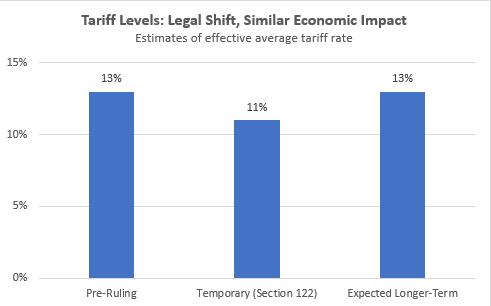
Although the headlines suggested a major shift, the practical economic impact appears more modest.
Current estimates suggest that the overall level of tariffs may be slightly lower in the near term under the temporary structure. However, the administration has signaled that more permanent tariffs are likely to follow. As a result, the longer-term tariff environment may not look dramatically different from where it stood prior to the ruling.
From an inflation standpoint, much of the tariff impact has already been absorbed. While tariffs do raise costs at the margin, research suggests that a significant portion of the price-level effect is already reflected in current inflation data. The recent legal shift does not materially change that broader trajectory.
Refunds and Fiscal Questions
Another issue receiving attention is the possibility that previously collected tariff revenues could be refunded if courts require it.
Because tariffs are paid by U.S. importers to the U.S. Treasury, any refunds would go back to those businesses. That would increase private-sector cash flow — functioning somewhat like a temporary fiscal boost — but would also reduce federal revenues and widen the deficit in the near term.
The timing and outcome of any refund process remain uncertain.
What This Means for Markets
Stripping away the legal details, three realities stand out:
1. Policy uncertainty has increased.
Trade policy remains fluid, and further adjustments are possible. Markets tend to react to uncertainty, even when the underlying economic impact is limited.
2. Economic fundamentals remain intact.
Despite tariff-related volatility, corporate profitability and economic activity have remained resilient. The broader economic backdrop has not shown signs of destabilization tied specifically to tariffs.
3. Markets are reacting to process, not collapse.
Bond markets have shown limited response, suggesting much of this shift was anticipated. Equities have been more volatile, reflecting renewed trade-policy uncertainty rather than a sharp deterioration in fundamentals.
Over time, economic growth and corporate earnings remain the primary drivers of long-term market returns. Policy shifts and legal developments can create short-term volatility, but they do not, by themselves, determine market direction.

Bottom Line
The Supreme Court’s ruling altered the legal framework for tariffs, but it did not end them. The administration has already implemented alternative measures, and additional changes may follow.
Policy uncertainty is elevated. However, it has not meaningfully altered the underlying economic or earnings environment.
As always, separating structural developments from headline volatility is critical. While the legal pathway has shifted, the broader economic picture remains considerably more stable than the news cycle might suggest.
_______________________________________________________________________________________________________________________________________________

BRANDY NICLAI, CFA® CIO, Multi-Asset Strategies
Brandy Niclai serves as Chief Investment Officer of Multi-Asset Strategies at Alaska Permanent Capital Management Company. In
this role, she leads the firm’s multi-asset investment platform and is responsible for asset allocation, portfolio construction, and ongoing
investment oversight for institutional clients.
Ms. Niclai works closely with governing bodies and investment committees to align investment strategies with stated objectives, risk
tolerance, and fiduciary responsibilities. She is Alaska Native and brings an Indigenous-led perspective to her work with Native and
Tribal organizations, informed by both professional experience and an understanding of intergenerational stewardship.
Ms. Niclai has over 20 years of investment industry experience. She is a shareholder of the firm.
Education:
MBA, University of Alaska
BA, Washington State University
Credentials:
Chartered Financial Analyst (CFA®)
Series 65